
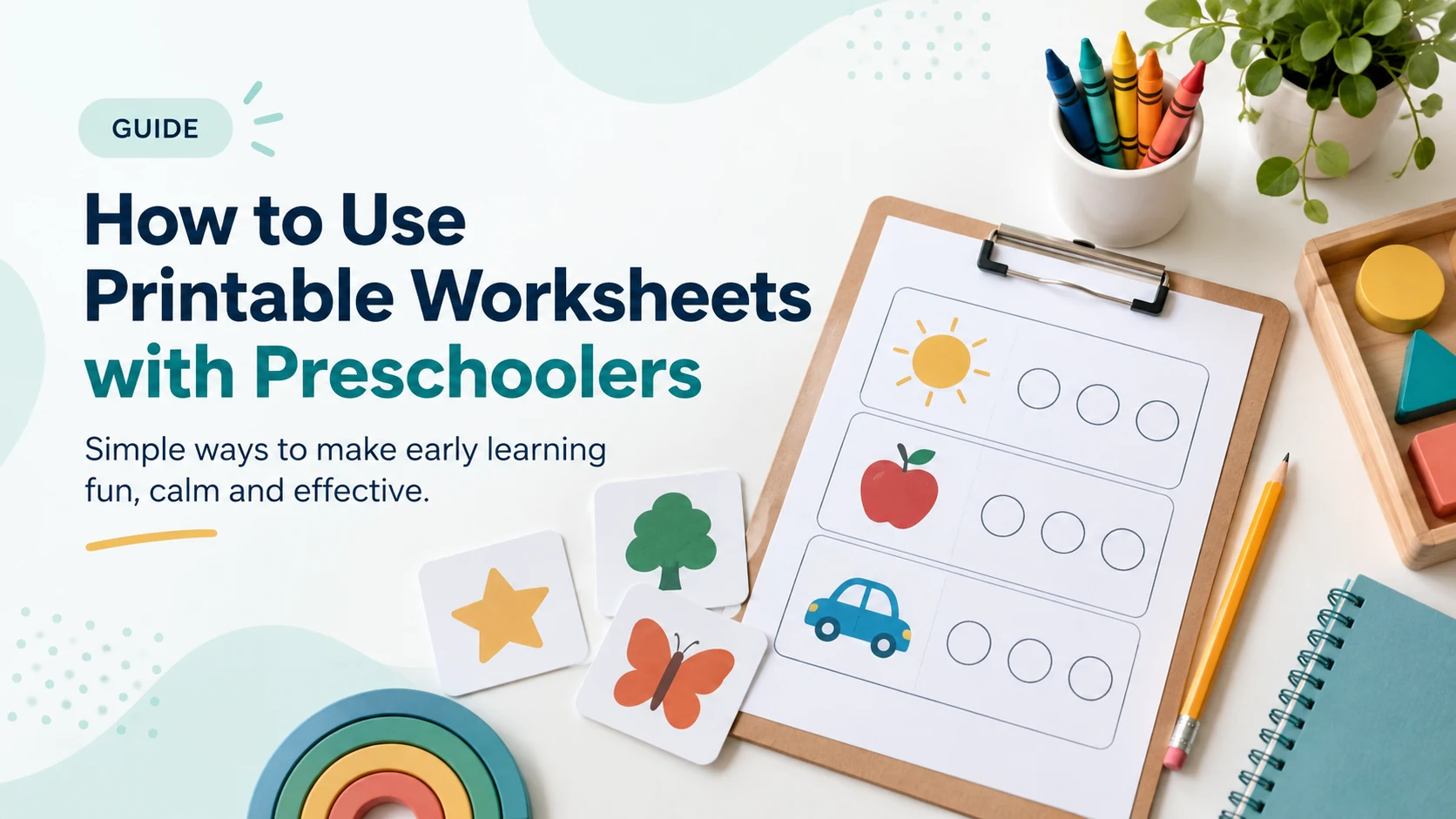
Printable worksheets can be a convenient way to introduce young children to simple learning activities. From matching pictures and recognising shapes to tracing lines and arranging events in order, a well-chosen worksheet gives children something they can explore and practise.
However, the way we introduce an activity matters just as much as the activity itself.
Preschool children learn in different ways and at different paces. Some enjoy sitting with crayons and completing a picture activity, while others prefer to move around, talk or explore objects before they are ready to work on paper.
The aim is not to finish as many worksheets as possible. It is to make each activity useful, comfortable and enjoyable.
Choose an Activity That Matches Your Child’s Interests
Before printing a worksheet, look at what it asks the child to do.
Is it about identifying familiar objects, matching pictures, tracing lines or finding differences? Does your child already recognise the objects shown?
Start with something that feels familiar.
For example, if your child enjoys animals, a picture-matching activity featuring animals may be more inviting than an unfamiliar topic. If your child likes drawing, a simple tracing activity might be a good starting point.
You can also let the child choose between two suitable activities. A little choice can make the experience feel more welcoming.
Prepare a Simple Learning Space
You don’t need a special study room or expensive supplies.
A comfortable table, a suitable chair, a printed worksheet and a few crayons or pencils are often enough.
Before beginning, check that the page is clearly printed and that the child can see the pictures easily. Keep extra materials nearby, but avoid covering the table with too many items.
You can introduce the activity with a simple sentence:
“Let’s look at these pictures and see what we can find.”
This creates a friendly beginning without making the worksheet feel like a test.
Explain the Activity, Then Give Your Child Time
Young children may need help understanding instructions, especially when they encounter a new type of activity.
Read the instructions aloud and demonstrate one example if necessary.
For a matching worksheet, you might point to a picture and ask:
“Can you find another one that looks the same?”
For a sorting activity, you could say:
“Which of these things do we wear?”
Once the child understands the task, allow time to explore and respond.
Try not to point out every answer immediately. Sometimes a short pause gives children an opportunity to notice something on their own.
Turn the Worksheet into a Conversation
A worksheet doesn’t have to be a silent activity.
Talking about the pictures can make the experience more interesting and encourage children to explain what they notice.
For example, while completing a sorting worksheet, you could ask:
- “What do you use this for?”
- “Where have you seen this before?”
- “Why do you think these two belong together?”
If an activity involves putting pictures in order, invite the child to describe what happens first, next and last.
You don’t need to ask questions about every picture. Choose a few natural opportunities to talk, and follow the child’s interest.
Give Support Without Taking Over
It’s normal for preschool children to need help with some activities.
If your child chooses an unexpected answer, ask what they noticed before correcting it. Their explanation may help you understand how they approached the task.
You might say:
“Tell me how you chose that picture.”
If the instruction was unclear, explain it differently or demonstrate another example.
Try to focus on the child’s effort, observations and willingness to explore rather than expecting every answer to be correct.
If an activity becomes frustrating, it’s fine to stop and return to it another day.
Connect Paper Activities with Everyday Experiences
Printable worksheets can be a starting point for other learning experiences.
After completing a picture-sorting worksheet, you could invite your child to sort a few everyday objects into groups.
After a sequencing activity about growing a plant, you might look at seeds or observe a plant together.
A worksheet about shapes could lead to a simple search for circles, squares and triangles around the home or classroom.
These small connections help children relate what they see on paper to the world around them.
Worksheets are most useful as one part of a varied learning experience that also includes play, conversation, stories and hands-on activities.
Keep the Experience Flexible
You don’t need to complete an entire worksheet pack in one sitting.
One activity may be enough for the day. On another occasion, your child may be interested in continuing.
Pay attention to how the child responds. If they are engaged, allow time to explore. If they seem tired or lose interest, consider taking a break.
There is also no need to repeat the same activity until it looks perfect.
The purpose is to provide opportunities to practise, notice, ask questions and enjoy learning—not to complete pages simply for the sake of finishing them.
A Final Thought
Printable worksheets are tools, not a complete learning programme.
Their value comes from how thoughtfully we use them. A simple matching activity can lead to an interesting conversation. A sorting worksheet can become a game. A sequencing activity can encourage a child to tell a story in their own words.
Start with one suitable activity, offer help when needed and let the experience develop naturally.
Over time, these ordinary learning moments can become a meaningful part of everyday life.